
Gout
Gout is a form of inflammatory arthritis that develops when uric acid builds up in the blood and forms needle-shaped monosodium urate crystals in a joint and in the tissue around it. The immune system reacts to those crystals, and that inflammatory response is what produces the sudden, severe pain, swelling, redness, and warmth of a gout flare. The base of the big toe is the classic site, though the ankle, knee, midfoot, wrist, and fingers can also be involved, and flares tend to recur and limit movement in the affected joint. In long-standing cases, urate can accumulate in visible deposits known as tophi, and joint damage may develop over time. Gout is diagnosed by a clinician, and its management, including any dietary management, is directed by a physician or other qualified healthcare provider.

How Medical Foods Can Help
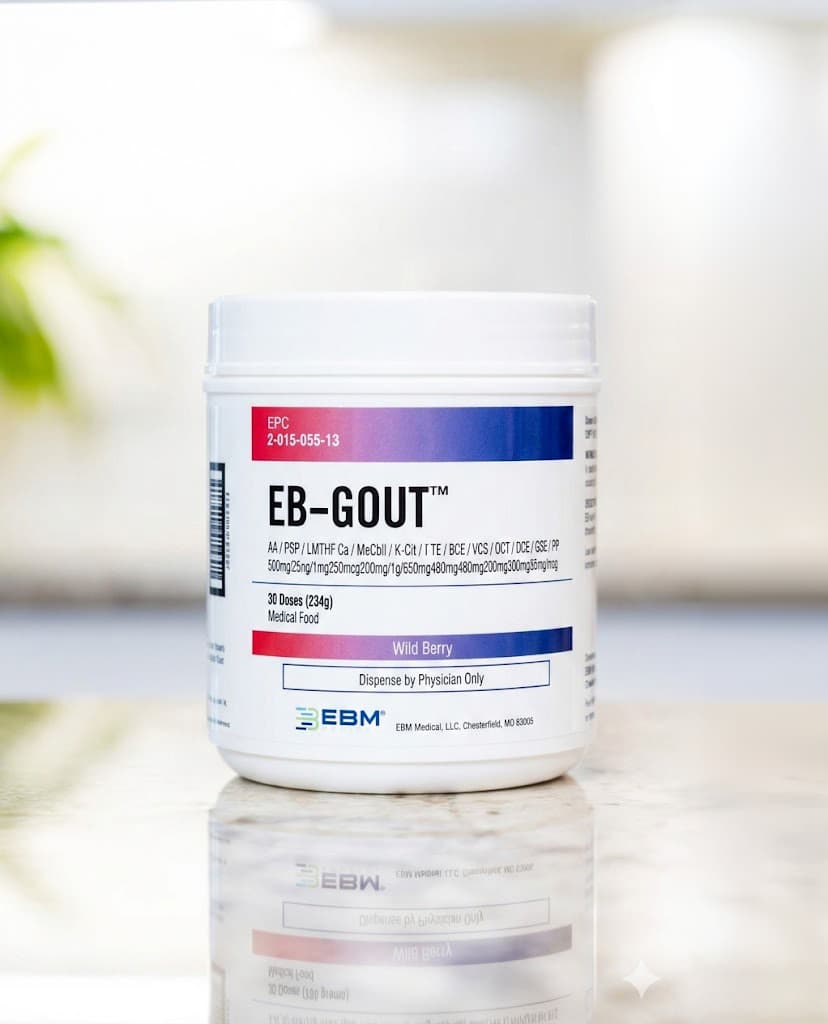
A medical food is formulated to be consumed under the supervision of a physician for the dietary management of a condition with distinctive nutritional requirements, and it is neither a drug nor a dietary supplement. In gout, the relevant nutrition science centers on purine metabolism: uric acid is the end product of purine breakdown, formed by way of the enzyme xanthine oxidase and cleared largely by the kidneys. Iaomai's EB-GOUT is a medical food formulated for the dietary management of the metabolic processes associated with gout, and it supplies tart cherry extract, quercetin, turmeric curcumin, and bromelain, plant compounds that nutrition research has examined in connection with purine metabolism and the body's own inflammatory pathways. Describing that research is a statement about what investigators looked at, not a statement about what EB-GOUT does: EB-GOUT is not intended to diagnose, treat, cure, or prevent gout, gout flares, or any other disease. It is intended for consistent daily use as part of the care plan your physician directs, alongside your prescribed medication and dietary guidance rather than in place of them.
Purine and Uric Acid Pathways
Uric acid forms when the body breaks down purines, a process involving the enzyme xanthine oxidase, and the kidneys clear most of it. EB-GOUT supplies tart cherry extract and quercetin, plant compounds that nutrition research has examined in connection with that pathway. This is background nutrition science, not a claim about what EB-GOUT does to uric acid levels.
Compounds Studied in Inflammatory Signaling
Inflammation is one of the body's own processes, and researchers have studied a range of food-derived compounds in connection with it. EB-GOUT provides turmeric curcumin and bromelain, two compounds that nutrition research has investigated in that context. EB-GOUT is not intended to treat, prevent, or shorten a gout flare.
Formulated for Dietary Management
EB-GOUT is a medical food, not a drug and not a dietary supplement, formulated for the dietary management of the metabolic processes associated with gout under the ongoing supervision of a physician. It does not replace prescribed medication.
Common Symptoms
- Sudden severe joint pain, typically in the big toe
- Swelling, redness, and warmth in affected joints
- Limited range of motion
- Recurring acute attacks
- Chronic joint damage in advanced cases
What Causes Gout?
Uric acid is the end product of purine breakdown. Purines from food and from the normal turnover of the body's own cells are converted to uric acid by way of the enzyme xanthine oxidase, and the kidneys clear most of it. Monosodium urate crystals can form in joints and surrounding tissue when uric acid in the blood rises above the level at which it stays dissolved, a state called hyperuricemia. In most people, the predominant factor is reduced clearance of uric acid by the kidneys rather than overproduction, which is why dehydration, chronic kidney disease, and certain diuretic medications are recognized contributors. Uric acid production can also rise: purine-rich foods such as red meat, organ meat, and shellfish contribute to the body's purine load, and fructose metabolism increases uric acid formation, so sugar-sweetened drinks and foods made with high-fructose corn syrup are associated with higher uric acid levels. Alcohol, and beer in particular, both supplies purines and reduces renal excretion of uric acid. Obesity, metabolic syndrome, insulin resistance, and elevated triglycerides are associated with hyperuricemia, and age, sex, genetics, and certain medications also shape individual risk. Hyperuricemia alone is not gout: many people with a raised uric acid level never develop it, and only a clinician can evaluate what is driving uric acid levels in a given person.
Medical Foods for Gout
Our scientifically-formulated medical foods are designed to address the nutritional needs specific to Gout.
Gout
EB-GOUT
Targeted medical food formulation for gout management and uric acid support.
$99.99
Add to Cart“Dr. Hecker recommended a genetic test, which revealed a mutation in a gene. After a year on a supplement, my almost constant shin pain is nearly completely gone. I am back to running normally. Amazing knowledge of such a unique field of study.”
Individual experience. Results vary from person to person and are not typical or guaranteed. Testimonials describe one person's experience and are not evidence that any product will work for you. Iaomai Health products are medical foods for the dietary management of specific conditions, intended for use under the supervision of a physician.
Struggling with Gout?
Our healthcare professionals can help you decide whether a medical food fits the dietary management of your condition, as part of a care plan they supervise.
Request ConsultationFrequently Asked Questions
Get answers to common questions about Gout and our medical food approach.
Related Conditions
Explore how medical nutrition supports other related conditions that may co-occur or share similar underlying mechanisms.